How the Harmony of Conflict Can Transform Your Workplace
“Your voice doesn’t matter here.”
I think back to workplaces I’ve been in where this phrase has been said, or implied. Perhaps you’ve experienced those spaces too, where the ideas, questions, or initiatives are dominated by a small group of powerful voices, leaving little room for discussion or cognitive dissonance among the full group. Yet, I know that some of the most productive spaces I’ve been in allowed for multiple voices, with differing perspectives to collaborate, listen, and solve challenges together.
Dissonance, in fact, can be a good thing. Consider the complexity of a song to understand how differing voices are a necessary part of finding a harmonic resolve within an organization. Because even in the best pieces of music, the melody is brought to life by a contrasting harmony. The resolution of that dissonance or tension is often the element that propels a piece of music forward from good to great.
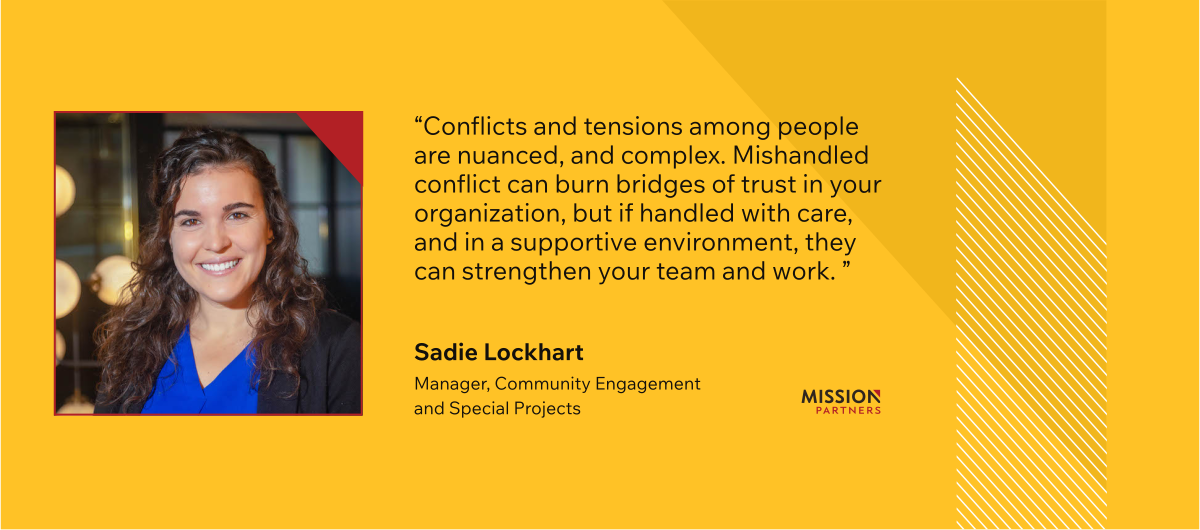
Like the dissonance of a song, conflicts and tensions among people are nuanced, and complex. Mishandled conflict can burn bridges of trust in your organization, but if handled with care, and in a supportive environment, they can strengthen your team and work. According to a 2022 study by the Niagara Institute of 700 professionals from around the world, a collaborative conflict management style, where everyone felt heard and worked together for a solution, was preferred by 59.8% of respondents. When conflict is handled in productive way, and with space for differing voices, a greater opportunity is presented—an opportunity to get clear on your values, to ensure core alignment across your team, and then use the gift of differing opinions to strengthen your work. Just as the dissonance in a song ultimately resolves to create a fuller and richer piece of music, the conflict in a story ultimately resolves to create a more complete and engaging narrative.
How then do you make space for the inevitable conflicting ideas that will arise, and better yet, how do you turn those opposing clashes and dissonance into productive conflict? As Mariah Levison, CEO and President of the Convergence Center for Policy Resolution, shared recently on the Mission Forward podcast, “When we do the hard work of understanding why people have different ideas…then we have the possibility to come up with solutions that are wiser and more durable than any one side could have come up with on their own.”
Setting the tone and space for that kind of productive conflict usually starts in the same place: with leadership.
To create an environment where your team feels they can productively disagree and move toward a collective resolve, consider how your leadership team can encourage conflict and differing ideas, not dismiss them. To cultivate this type of culture, consider the following steps:
- Prioritize People First. Set the stage for a culture that centers people at the forefront of your work, that recognizes that people are so much more than their work, and that, as Mission Partners’ Founder, Carrie Fox shares, a culture that says, “You belong here. And you don’t have to choose between being who you are and being who we need you to be.” Learn more about centering people first in your work and creating spaces where your team can show up as their whole selves.
- Establish a Brave Space. As my colleague Nimra Haroon defines it, “brave spaces open dialogue about challenging topics, encouraging perspectives to be voiced without a fear of judgement, exclusion, and discrimination.” Learn more about creating a brave space.
- Cultivate a Psychologically Safe Workplace. According to the Center for Creative Leadership, “Colleagues who feel their work environment is psychologically safe are more willing to engage in interpersonal risk-taking behaviors that contribute to greater organizational innovation — like speaking up, asking questions, sharing unspoken reservations, and respectfully disagreeing.” Learn more about establishing psychological safety in your workplace.

With that foundation, and to further support your team for productive conflict and respectful disagreement, consider incorporating P.E.A.C.E., a conflict resolution model I developed to help in moments when interpersonal conflicts and differing views arise in your workplace:
- Pause. Collect yourself and consider taking a step away from your computer, team, or the source of tension. Find a way to ground yourself and look for alignment and clarity around the core of the conflict. Or perhaps invite the possibility that this differing view might be an opportunity for gratitude, as it allows you to strengthen this relationship, product, or your team.
- Evaluate. Consider the following questions: What has occurred that led to this conflict? What ideas or comments may I be misunderstanding? Or what is the opportunity to see the differing idea or opinion in a new way? How can I listen more deeply to the other person’s perspective?
- Ask. Thank the other person for sharing their opposing views and ask if they’d be open to connecting about it further so that the best solution can be reached together. There may be a new possibility to be discovered altogether.
- Converse. Stay curious. Review the ideas shared and ask more questions. Consider this conflict from the other person’s perspective. Actively listen and seek to understand, then play out each scenario, idea, and possibility.
- Explore. Perhaps there is a new possibility, solution, or finding that you and the other person have never considered. Work to discover that solution together. Regardless of where you land on the solution, centering on curiosity and gratitude will allow this productive conflict to strengthen your relationship.
As you invite these practices into your own communication, and as you and your leadership team establish the foundation for an environment that practices productive conflict, consider opportunities to practice these skills with your team. Take the necessary steps to ensure your team feels safe engaging in productive conflict. Creating a space where you can address, listen to, and resolve the dissonance of your organization will strengthen your team and their collective work. Ultimately, your workplace harmony and mission advancement may be better for it.



 Check out our new